Systems ·
Lord of Mysteries Adds Caravan Trading and Club Taxes on October 15
The Chinese MMO's Trade War preview explains changing prices, travelling merchants and club-controlled taxes ahead of the October 15 update.
The Chinese Lord of Mysteries MMO will add caravan trading in its October 15 update, with players buying goods, sending them between stations and paying taxes to the clubs that control those stops. After the Roselle raid’s number puzzles, the next calculation is how much profit survives the journey.
The game’s official TapTap moderator, Suzie, outlined 贸易战争 [mào yì zhàn zhēng], translated here as Trade War, in an October 9 preview. A separate update announcement puts the new trading mode alongside cosmetics and events in the October 15 release.
Each player gets a caravan. The caravan travels for you, while you choose where to buy, where to sell and whether to accelerate a trip. The preview describes a market in which each station has its own local goods. Plentiful stock pushes prices down; players buying out that stock push prices up.
That makes a profitable route a moving target. The team says trading depends on price differences and timing, rather than damage output or equipment score. It also tells players to watch caravan stamina and upgrade their vehicle. The post does not give the upgrade costs or a complete list of travel costs.
Travelling merchants can change the price
The 鲁恩商报 [lǔ ēn shāng bào], or Loen Commerce Gazette, supplies information about merchant groups moving around the world. It reports their locations and helps players judge whether they can reach a stop before a group leaves.
Two groups affect different sides of a trade. 流金商团 [liú jīn shāng tuán], translated here as the Flowing Gold Trading Company, raises the price at which players can sell goods at a station. 丰饶商团 [fēng ráo shāng tuán], the Abundance Trading Company, lowers purchase prices for the relevant goods. Their visits are temporary, so a better price at a distant station comes with a time limit.
The official advice is to check the newspaper before dispatching cargo. A merchant discount is less useful if the caravan cannot reach it in time, or uses too much stamina on the trip.
Clubs collect the taxes
After strategic-server activities end, winning clubs receive control of trade stations, according to the preview. Their flags appear at those stations, alongside the local tax rate. Club managers can adjust that rate, and more trading at a station means more tax revenue.
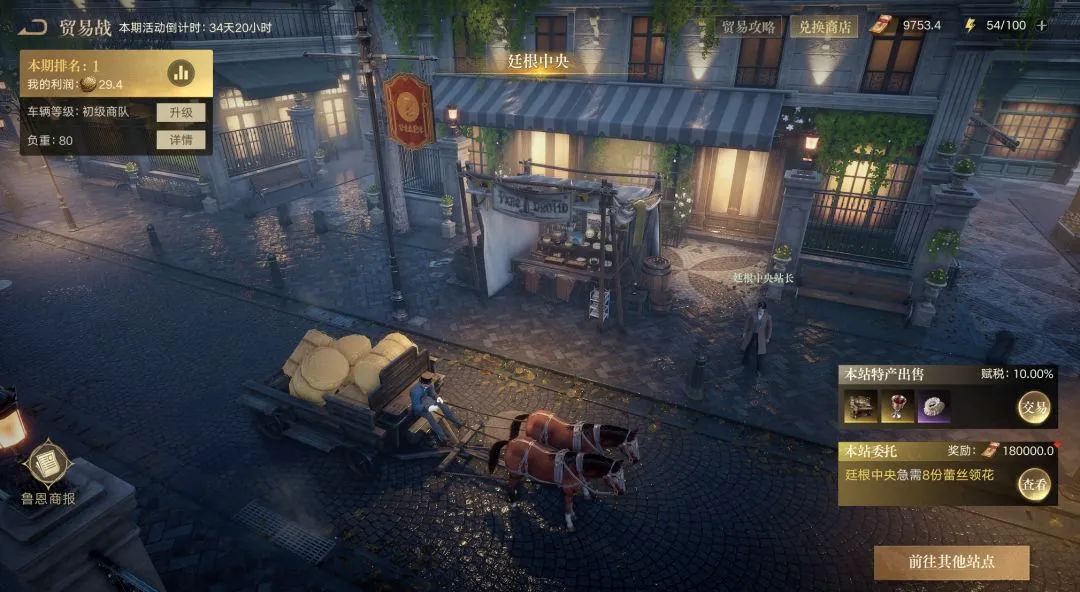
The published screenshot shows a cargo cart at 廷根中央 [tíng gēn zhōng yāng], Tingen Central, with a 10.00 percent tax beside the station’s goods. That is a value in the preview image, not a confirmed universal rate. Players will need to compare the tax at each stop as well as its sale prices.
Some useful labels in that interface are:
| Chinese label | English meaning |
|---|---|
| 交易 [jiāo yì] | Trade |
| 本站委托 [běn zhàn wěi tuō] | Station commission |
| 前往其他站点 [qián wǎng qí tā zhàn diǎn] | Travel to another station |
| 升级 [shēng jí] | Upgrade |
| 鲁恩商报 [lǔ ēn shāng bào] | Loen Commerce Gazette |
The team also tells new traders to complete daily commission tasks for their starting funds. Those tasks, local taxes and caravan stamina are the first costs and resources to check before committing to a route when the update arrives.